
A Brew Through Time: The History of Farrer’s Tea & Coffee House
Nestled in the heart of the picturesque market town of Kendal, Farrer’s Tea & Coffee House is more than just a café—it’s a living, breathing part of Cumbrian history. For over two centuries, the aroma of fine loose-leaf teas and artisan-roasted coffee has wafted through its charming 17th-century building, inviting locals and visitors alike to pause, sip, and soak in a story that spans generations.
In this blog, we take you on a journey through the rich history of Farrer’s, tracing its roots from a humble merchant business to a beloved institution of British tea and coffee culture.
Origins: From Merchant House to Coffee Legacy
The history of Farrer’s begins in a building steeped in history long before a single coffee bean was ever roasted within its walls. Built in 1637, the property at 13 Stricklandgate first served as a residence for George and Mary Wilson. By the 1670s, it had transformed into The Wagon and Horses Inn, a packhorse rest stop for travellers passing through bustling Kendal—known as the gateway to the Lake District.
In the early 1800s, entrepreneur Joseph Fallows started trading tea, coffee, cocoa, and refined sugar on the premises. But it was in 1819 that the story truly began to brew, when John Farrer, a Quaker from Grayrigg, purchased the business and established what would become Farrer’s Tea & Coffee House.
The Quaker Roots and Family Business
The Farrer family, like many early Lakeland business people, were devout Quakers—known for their integrity and community values. John Farrer and his wife Ann raised their sons to respect tradition and hard work. Their son, John Farrer II, joined the family business and later handed it down not to his daughters, but to his nephews Joseph and Edward, continuing the Farrer legacy in line with Victorian-era business customs.
For decades, the business remained in the extended Farrer family before eventually passing to the Watson family and then on to independent ownership in the 1900s. Yet, throughout all the changes, the shop’s core mission—to provide high-quality teas and coffees—remained unchanged.
A Building with Timeless Character
Step inside Farrer’s today and you’ll instantly feel its historic charm. The 17th-century oak floorboards, which once formed the decks of merchant clipper ships, still creak underfoot. Dozens of people walk these planks every day, and yet they are as sturdy and full of character as ever.
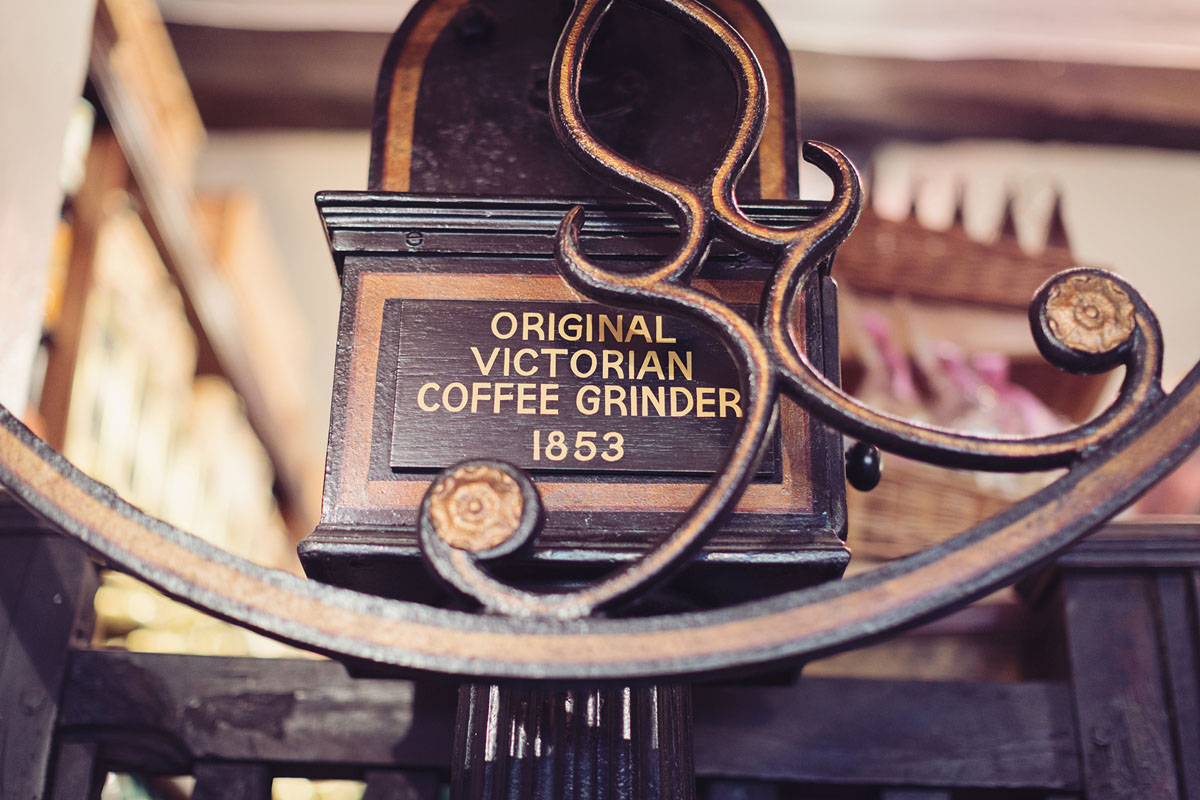
One of the most iconic features of the building is the massive tea counter just inside the entrance. Behind it sit 20 original Victorian brass tea canisters, all still in use and protected as listed features. The stunning Victorian coffee grinder, dated 1853, stands proudly in the centre of the shop—a reminder of the days when coffee roasting required both muscle and patience.
In fact, the entire building was designated a Grade II listed property in 1951, largely due to its incredibly preserved interior. With original staircases, panelled counters, fireplaces (including one dated 1644), and vintage doors, every detail whispers of centuries gone by.
Personal Stories That Shaped the History of Farrer’s
The history of Farrer’s is not just about bricks, tea, and coffee—it’s also about the people who shaped its legacy and these people are honoured on the walls of our shop.
Charles Ernest Travis: A Devoted Tea Maker Turned Soldier
Born in Kendal in 1889, Charles Ernest Travis started work at Farrer’s as a tea maker before enlisting in the Border Regiment during World War I. Known for his cheerfulness even amid the horrors of war, Charles was tragically killed at age 27 on the Somme in 1916. His sacrifice is commemorated by a copper plaque in his honour at Farrer’s and on the memorial at St. Oswald’s Church.
Jack Ferguson: The Brave RAF Flight Engineer
Another poignant story is that of Jack Ferguson, who began working at Farrer’s at the age of 14. At 18, he volunteered for the RAF during World War II, becoming a Flight Engineer. On April 18th, 1944, his plane was tragically shot down upon returning from a bombing mission over France. Jack’s bravery and sacrifice are a deeply respected part of Farrers’ history. His remains were found in 1995 and now form part of a museum exhibit in Witchford.
Modern Day Farrer’s: A New Chapter with Old Traditions
In 1990, Farrers began a new chapter when it was purchased by the Grace family, who continue to run the business today. Now in its second generation, Farrer’s Tea & Coffee House has grown into a bustling café and shop that still honours its historic roots.
Visitors can enjoy a wide variety of freshly prepared cakes, pastries, and light meals, all paired with the finest teas and coffees sourced from around the world. The business also stocks a broad range of loose-leaf teas, roasted coffee, and an impressive collection of tea and coffee-making accessories.
Meanwhile, the John Farrer & Co. roastery remains based in Kendal, continuing the tradition of artisan coffee roasting that began over 200 years ago. Their products are now supplied not just to the café, but to establishments across the Lake District and beyond.
Why the History of Farrer’s Matters
So why does the history of Farrer’s matter? Because it’s a rare example of how tradition and quality can endure the test of time. It’s a place where the past isn’t hidden away in a museum—it’s lived every single day, in the creak of the floorboards, the clink of a brass tea canister, and the aroma of a freshly brewed cup.
Farrer’s Tea & Coffee House isn’t just a spot for a drink—it’s a destination for those who value craftsmanship, heritage, and a story that’s still being written with every customer who walks through its historic doors.
Visit and Be Part of the Legacy
Whether you’re a tea connoisseur, a coffee aficionado, or a history lover, a visit to Farrer’s is a must when in Kendal or the Lake District. Sit in the same rooms where generations of Cumbrians have sipped and savoured, and become part of the enduring history of Farrer’s.
After all, what better way to experience history than with a warm cup of tradition in your hands?

Recent Comments